


Dinho Bento is a Brazilian artist, born in Mariana, currently living in Debrecen. Recently he installed beautiful artworks in the Great Forest of Debrecen.
Tell me about yourself a little bit. On your Facebook page, we can see a lot of amazing artworks, but I’m interested in you as a person now. Where were you born? Where did you grow up? Have you learned art in school or is this your natural talent?
I was born and raised in Mariana, Brazil. Mariana is a small historic town but very visited by people from all over the world due to its great importance for Brazilian history. It is also a region that attracts many artists, poets, and musicians, as it hosts several festivals related to the cultural scene. As I grew up in this environment, my interest in art began as a child, visiting the ateliers of local artists and participating in workshops and exhibitions at festivals.
When I was 16, I started studying art at FAOP (Ouro Preto Art Foundation), and after that, I decided that I really wanted to be an artist. Later, I finished a technical course in Graphic Design and started a BA in Fine Arts at the Guignard School – UEMG (State University of Minas Gerais), in Belo Horizonte.

What is your journey as an artist? When did you first share your artwork in a public space? And what are your plans for the future? Tell me a bit about your current projects if it is possible.
I usually work in different segments, from drawings and paintings on canvas, to street art and mural projects around the world.
In my teenage, I was very influenced by urban artists from big cities in Brazil, which I used to see in graffiti and street art magazines. My first art in the public space was at a skatepark in the city. Soon after, the city government hired me to make a mural on the facade of a gymnasium, which was my first paid job. Gradually, I developed my own style according to my roots and influences. Thus, I started to find space to present my work on projects in Brazil and other countries. In 2017, I was one of the four Latin American artists contemplated for a project in France, where I made artworks, exhibitions, and an artistic residency. This experience encouraged me to dedicate myself even more to this field of art and has opened doors to other projects around the world.
Currently, due to the pandemic, the projects that I was invited to participate in have been postponed since the beginning of 2021, and I still don’t know when they will return. I am only working from home, making my paintings, and working with clients, mainly from Brazil, who always commission me jobs like digital illustrations and other graphic design services. I recently received an invitation to an exhibition in Paris, which will take place in October, so I have already started to work on the artworks that I am going to exhibit there.
I don’t usually plan for a long-term future. I prefer to focus on the opportunities of the moment to make the most of them. However, when I think of a distant future, I imagine myself more dedicated to art galleries, but keeping some street art projects.
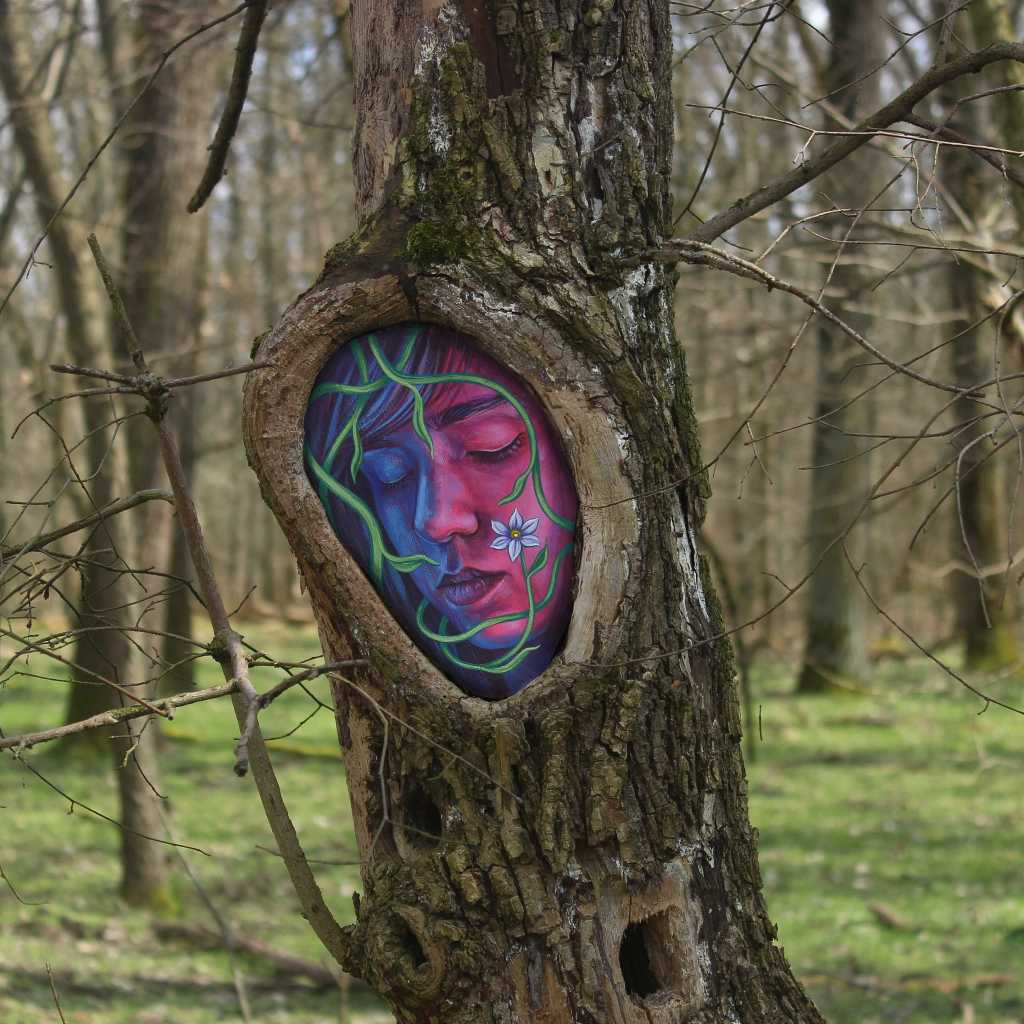
In February you installed two beautiful painted artworks into tree knots here in Nagyerdő, Debrecen. What inspired these two artworks? It’s like a fantasy movie setting. And do you have projects in Debrecen or why are you here, in our city?
I’ve been living in Debrecen for three years. I’m here accompanying my wife, who is finishing her Ph.D. at the University of Debrecen. We love to live here, but unfortunately, our time here ends this year.
We always like to walk around the park, and I really admire some of the art installations I see there. As I have not been doing art in public spaces for a long time, due to the current situation, I thought about these installations as a way to stay active in this public art scene, making it in a place that inspires me a lot.
Tree knots have already been an inspiration for a series of paintings on canvas that I have been working on since last year. So, I thought of a way to apply the same concept, but directly to the element that served as inspiration, creating a more fantastic and unusual relationship between the work and the viewer. I thought of doing this so that the painting was not directly applied to the tree, avoiding any damage to the tree, and making it easy to remove when necessary. For this, I decided to make the paintings on a wooden board. Then, I cut them according to the shape of each knot, creating the impression that the image is inside the tree. In addition to the surprise element, I believe that this can make the viewer create a new relationship with nature, even if momentary.
I try to express the idea that we are literally part of nature. Denying our interconnection harms us all, individually and collectively, and taking care of nature is taking care of ourselves. I believe that when we see ourselves as part of nature, we are fundamentally connected to it. We do not see ourselves as separate, but as another species in a larger ecosystem in the natural world.
I don’t have any specific project in Debrecen, but I would love to do a mural or exhibition in the city, perhaps expressing the influences and inspirations I have here.
This tree installation is something that is between the notions of street art and land art, which category would you choose and why?
It is really difficult to classify. Perhaps it was a merger of the two categories. I am a street artist but mainly influenced by naturalistic elements, so I believe that this type of installation can be the vertex between these different universes.

Can you tell me the detailed process of how you do these installations? What is the method? And can you tell us something about your creative process in general?
For these installations, I usually use a sheet of paper and a pencil for taking the shape of the tree knot. At home, I transfer the mold to a thin wooden board, where I paint with water-based paint. To fix it, I use a plastic paste that does not leave residues on the tree and can be easily peeled off in case the work needs to be removed.
My creative process varies according to the type of project. In general, I like to work from the photographs that I take and apply the image interacting with elements of my imagination. I also like to portray elements and people from the place where I am, consolidating myself a deeper experience with the place.


You have a lot of amazing murals, do you work as a hired artist? Do you generally have permission to install your artwork?
I am usually invited to participate in festivals where each artist has a wall available to work with their art. This type of festival has been growing all over the world, so I have already had the opportunity to work in more than ten countries. Unauthorized paintings are very common in street art. However, in this situation, I prefer to make them in abandoned or non-private spaces, to avoid any problems.
How would you describe your painting or artistic style? What are your favorite themes? Are there any particular cultures that have influenced your aesthetic?
I think I am more attracted to the human figure and elements of nature. I am very influenced by the Brazilian fauna and flora, as well as by the culture of the native people from my country. However, I have been moving towards a surrealist aesthetic, where I feel free to compose and portray any elements. As I grew up in a city surrounded by forest and with very rich fauna, I have always been influenced by this memory of nature. Since I studied scientific illustration, in an extension course at the university, I studied more deeply various species of plants and animals, so I also try to apply this knowledge to something that I have already brought from my roots.

Were there any particular artists who inspired you to get your vision out on the streets?
Many artists have inspired me. From old artists like Candido Portinari (which I consider the greatest Brazilian muralist) to contemporary artists like Banksy, the Spaniard Aryz, the Ukrainian Aleksei Bordusov … well, there are many that I could mention here, in addition to the artists who grew up and painted with me, or the artists I have met on projects around the world. Even though my work is not aesthetically similar to their style, they are artists who inspire me, as they are always reinventing themselves.
What do you think what is the role of the artist in society? What do you see as your personal mission?
The artist has a fundamental role in society, which is to show the world from another angle, through the artist’s private universe. It is a way of sharing our emotions and making people feel a little bit of what we feel. I believe in art as a way of narrating time, and connecting with the world through a universal language. Every job I do is an opportunity to get into people’s heads and stir up their emotions, even for a few seconds. That is why I always try to create images that convey lightness and reflection, even when I talk about tragic themes. As a Brazilian philosopher, Ferreira Gullar, said, ‘Art exists because life is not enough’.

Do you have any favorite artworks from your collection?
I believe my favorite work is always the latest because it is the works that translate my universe into the present. But there is a different feeling for each work because each one brings me to different experiences, that I lived and learned in that place, at that particular moment when the work was done. Each process is different, even if the steps are similar. And sometimes, for the artist, art is more in the process than in the finished work, because it is during the process that the artist often travels in ways not yet explored, discovering a little more of himself.
Do you prefer working alone or collaborating with others?
I am in a phase where I have been working alone for years. But I like to work collaboratively. Sharing the same canvas or wall with an artist is a way of understanding and learning how the other person’s mind works, how it is related to time, and the materials they use. So, exchanging experiences and learning is always good!

Author: Eleonóra Tisza


Hozzászólások